






New in Mathematica 14.3
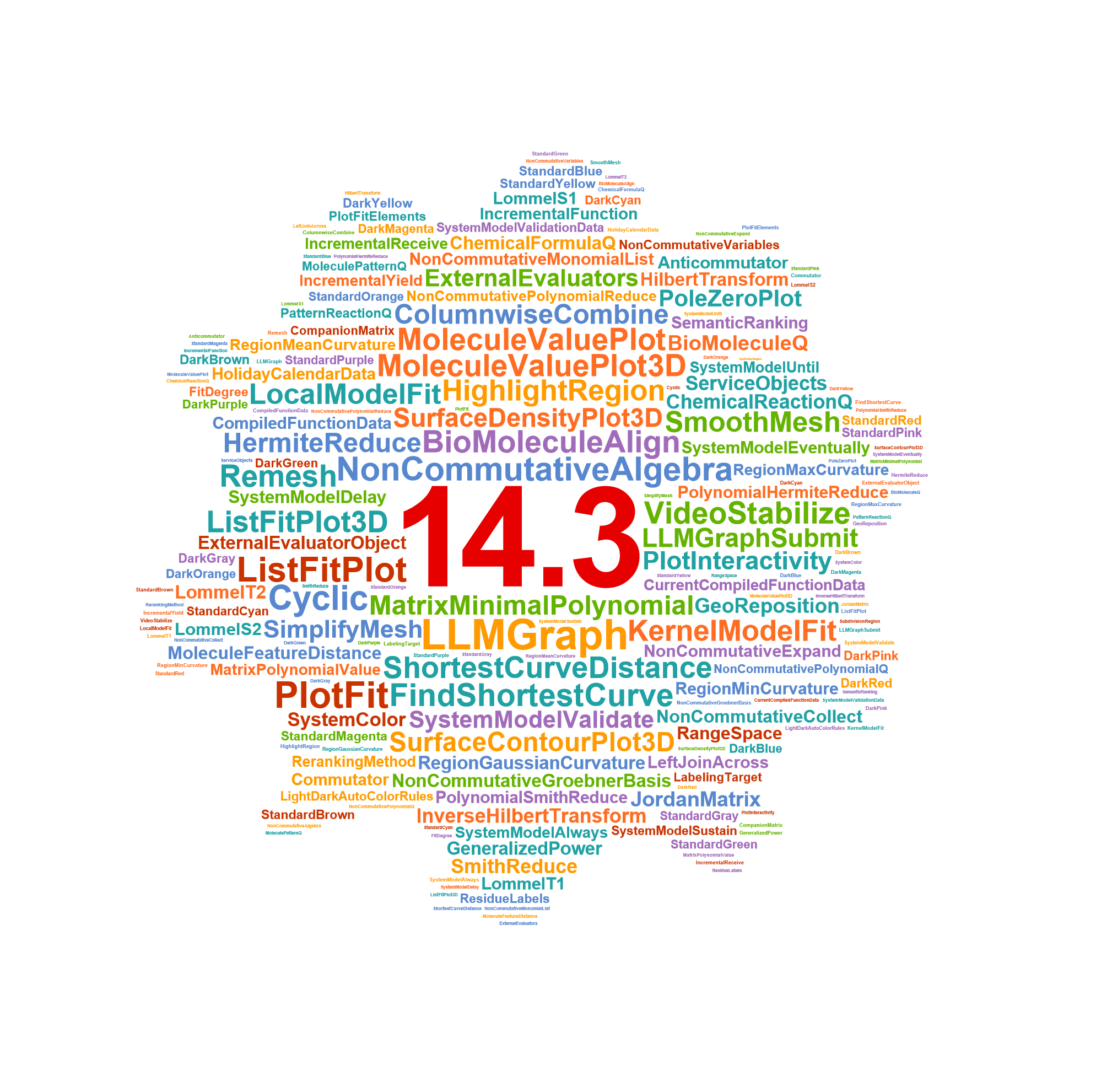
Mathematica 14.3 adds full support for dark mode and introduces new standard colors designed for both dark- and light-mode environments. It completes the implementation of noncommutative algebra and adds Hilbert transforms, Lommel functions and new matrix decompositions. Visualization capabilities expand with ListFitPlot for automatic curve fitting, surface plotting functions, vector-based maps and mesh processing tools. Other key additions include geodesic computation, LLMGraph for AI workflow orchestration, significantly faster Python and R integration, ColumnwiseCombine for tabular data operations, system model validation tools and Markdown export support.
 Stephen Wolfram's Blog Entry announcing Version 14.3
- Represent an infinite, repeating sequence with
Cyclic - Schedule and combine multiple LLM generation steps with
LLMGraphandLLMGraphSubmit - Many feature extractors can now work without training
- Perform local polynomial regression with
LocalModelFit - Perform function approximation via smoothing kernels with
KernelModelFit - Multiple functions added to represent noncommutative algebras and perform operations on polynomials in such algebras, including
NonCommutativeAlgebra,GeneralizedPower,Commutator,Anticommutator,NonCommutativeExpand,NonCommutativeGroebnerBasis,NonCommutativePolynomialReduceand more - Compute the eigenvalue decomposition of a diagonalizable matrix with
EigenvalueDecomposition - Compute the Frobenius decomposition (block companion) of a matrix with
FrobeniusDecomposition PolynomialHermiteDecompositionperforms the Hermite decomposition of a polynomial matrixPolynomialSmithDecompositionperforms the Smith decomposition of a polynomial matrix- Compute the Hilbert transform and the inverse Hilbert transform of a function with
HilbertTransformandInverseHilbertTransform, respectively - Lommel functions and modified Lommel functions of the first and second kinds have been added:
LommelS1,LommelT1,LommelS2,LommelT2 - Combine several tabulars, comparing values of common columns with
ColumnwiseCombine - Options for styling
Tabularand highlighting individual elements have been added GeoGraphicshas been updated; now uses vector maps, a new geometric engine and faster data access- Align biomolecules in 3D with
BioMoleculeAlign - Color atoms and bonds according to property values with
MoleculeValuePlotandMoleculeValuePlot3D MoleculeFeatureDistancecomputes the feature distance between moleculesShortestCurveDistancegives the minimal arc length between two points in a regionFindShortestCurvefinds the minimal arc length curve between two points in a region- Find the Gaussian curvature at a point of a region with
RegionGaussianCurvature - Simplify a mesh by reducing the number of triangles with
SimplifyMesh - Smooth a mesh by removing noise with
SmoothMesh SurfaceContourPlot3Dmakes a contour plot of a function on a surfaceSurfaceDensityPlot3Dmakes a density plot of a function on a surfaceHighlightRegionhighlights a specific region of interest in a region- Plot data with a fitted curve using
ListFitPlotandListFitPlot3D - Validate a design specification for a system model with
SystemModelValidate - Temporal design specification language for
SystemModeladded with new functionsSystemModelAlways,SystemModelSustain,SystemModelUntilandSystemModelDelay - Control system objects now support a range of properties, including differential equations
- Control system design functions now provide block diagram properties for documentation and understanding
- Stabilize shaky videos with
VideoStabilize - Image filtering functions such as
MeanFilterandGaussianFilternow work directly on video, filtering the video frame by frame - Exporting expressions and notebooks is now supported for the Markdown format
- Import and Export support added for the
JSONLinesformat - Support for dark mode in notebooks added
- Several new named colors added, such as
StandardRed,StandardGreen,StandardBlue,DarkRed,DarkGreen,DarkBlueand more - Symbolic representation of an evaluator system added with
ExternalEvaluatorObject - Find currently available external evaluator systems with
ExternalEvaluators
See the complete list of what's new in the Wolfram Language with Mathematica 14.3 at the Wolfram Research website