New in Amsterdam Modeling Suite AMS 2026
Amsterdam Modeling Suite, AMS, 2026 focuses on the integration of advanced machine learning (ML) potentials, simulation workflows, and usability. With expanded chemical coverage, improved performance, and streamlined tools, AMS 2026 makes it easier to run fast, automated, and reproducible research.
What's new in AMS 2026 at a glance
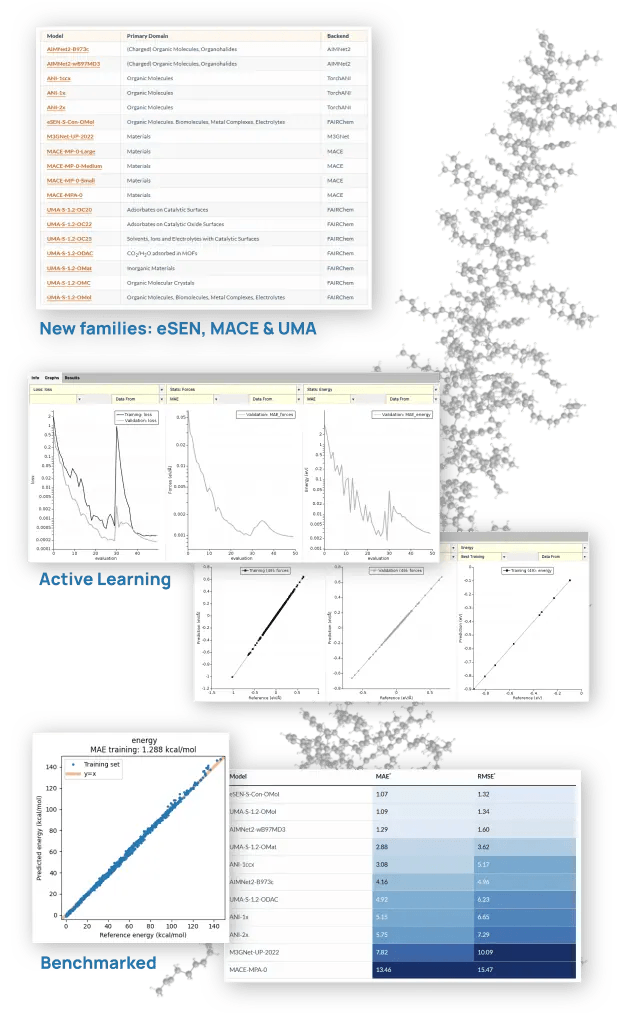
- Next-generation ML potentials: New model families (eSEN, MACE, UMA) deliver near-chemical accuracy, GPU-optimized performance, and expanded coverage - from biomolecules and catalysts to MOFs and inorganic materials
- Enhanced electronic structure (ADF): New capabilities for spectroscopy, excited states, solvation, and embedding methods
- OLED & multiscale workflows: Improved integration with Bumblebee, enabling deeper device-level insights and analysis
- Smarter GUI: New structure builders, streamlined menus, and improved visualization tools
- Advanced COSMO-RS: Better handling of complex, multi-component mixtures and phase behavior
- Stronger MD & driver: More robust simulations, new constraints, faster PES scans, and enhanced sampling methods
- VASP integration: Seamless workflow integration for materials modeling and active learning
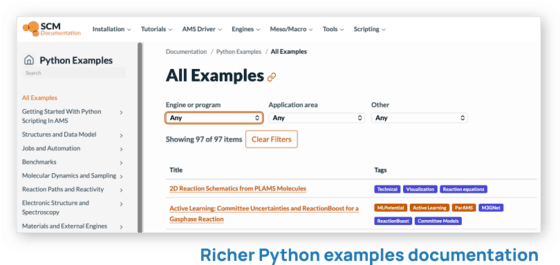
- Expanded Python ecosystem: More reusable examples, automation support, and easier scripting for reproducible research
Detailled View on New Features in AMS 2026
ML Potentials: Coverage and Performance
New model families (eSEN, MACE, UMA), trained on large datasets, extend the applicability of ML potentials while improving efficiency and accuracy in AMS 2026.
Extended coverage includes:
- Charged and magnetic molecules
- Biomolecules and polymers
- Metal complexes and catalytic interfaces
- MOFs and molecular crystals
- Inorganic materials
Performance improvements:
- Near chemical accuracy for many applications
- Optimized performance on GPUs
- Benchmarked and documented models
- Easy install via package manager
These capabilities support a range of workflows, including:
- Conformer screening
- Preoptimization
- Thermochemistry and reactivity studies
- Active learning (including MACE and M3GNet fine-tuning)
ADF
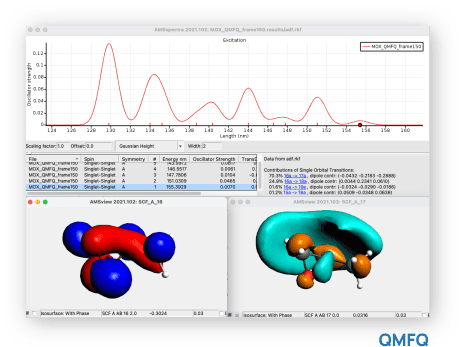
In AMS 2026, new functionality has been added to ADF to support a wider range of electronic structure and spectroscopic applications:
- GW with FQ (Fμ) embedding (polarizable)
- wFQ for plasmonic spectroscopies (surface-enhanced Raman scattering)
- Solvation Model 12 (SM12) analytical gradients
- Frozen-core approximation with LibXC
- ROKS-TDA and ROKS-TDA-SOC now include spin-flip-down excited states (improved description of unpaired electrons in TDDFT with Spin-orbit coupling)
- Excited-state geometry optimizations for open-shell TD-DFT+TB
- NMR chemical shielding with LibXC and range-separated XC functionals
OLED and Multiscale Workflows
Updates to OLED workflows in AMS 2026 improve integration with OLED device modeling (Bumblebee ) and analysis capabilities:
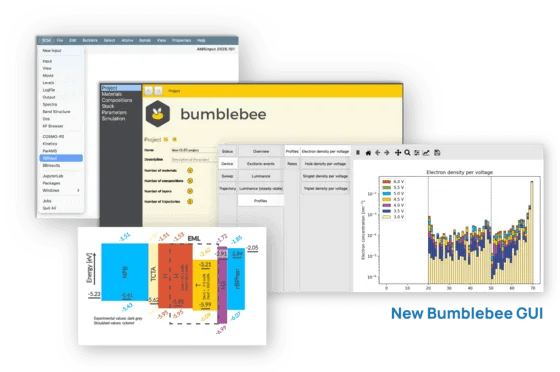
- NEW Bumblebee GUI & integration into OLED workflows
- Improved communication with Bumblebee
- Expanded analysis of transient behavior
- Support for exciton profiles, quenching, recombination, and degradation
Graphical User Interface
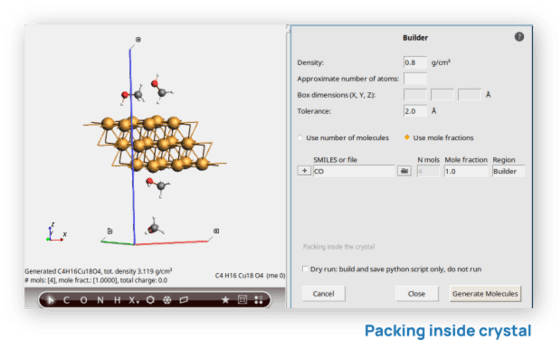
In AMS 20226, the GUI has been updated to simplify model setup and system construction:
- New structure builders (nanoparticles, nanotubes, micro-solvation)
- More compact and streamlined menus
- Improvements to AMSview and visualization tools
These updates to the Graphical User Interface in AMS 2026 aim to make common tasks more efficient while maintaining flexibility.
COSMO-RS
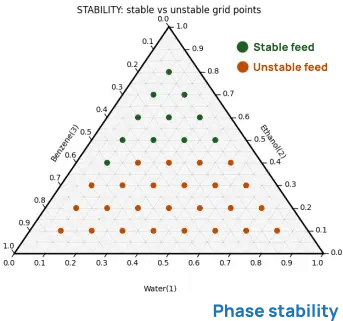
In version 2026 of COSMO-RS, new tools have been introduced for modeling complex mixtures:
- Liquid–liquid equilibrium solver for identifying tie lines
- Stability testing for miscibility and phase separation
- Support for multi-component systems
- Integration with Python workflows for phase behavior analysis
AMS Driver & MD
The AMS driver has been updated for AMS 2026 to provide more control and robustness in simulations:
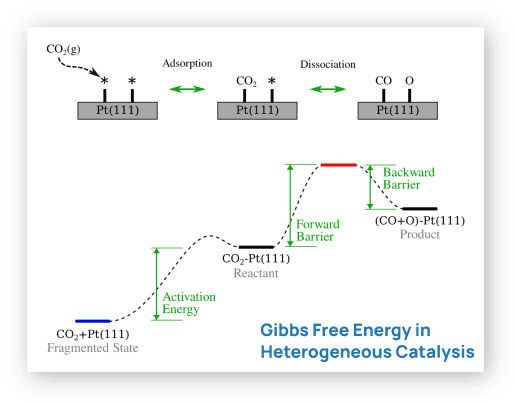
- Fast, rigid PES scans (“non-optimizing mode”) without relaxing other degrees of freedom
- Inclusion of Gibbs free energy in PES exploration
The molecular dynamics (MD) driver has also been improved in version 2026:
- Stability detection
- Smaller engine files and performance optimizations
- Advanced SHAKE constraints
- More flexible reflective boundary conditions
- Use AMS MD with InfRETIS path sampling
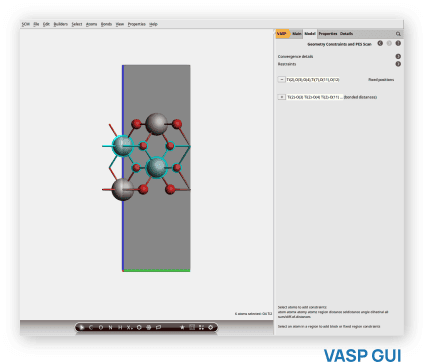
VASP Integration
VASP 6.4 is now supported as an external engine within AMS 2026 (not included in the Amsterdam Modeling Suite), enabling closer integration between workflows:
- Improved compatibility with AMS scripting and automation
- Support for active learning workflows
- Consistent output formats within AMS
- Expanded examples and tutorials
This integration supports materials modeling workflows within a unified environment.
Python Examples and Scripting
The Python ecosystem has been expanded in AMS 2026 to improve usability and reproducibility.
AMS 2026 offers a richer and more structured example library :
- Reusable examples across engines and applications (ADF, COSMO-RS, Batteries, etc.)
- Easier transition from GUI workflows to Python-based automation
Additional improvements to AMS 2026 include:
- More accessible AMSPython scripting for a wide range of users
- Support for automated and programmatic workflows
- Compatibility with LLM-assisted scripting approaches